
So, When Do These Compounds Actually Start Working? Here’s the Honest Timeline
A quick note before the questions start. This piece is not affiliated with Swiss Chems or any company named below, and it does not link to anyone’s order page. The only outbound links go to primary sources readers can check themselves: the FDA actions and the human trials behind these compounds. Compounded or prescribed peptides discussed here are not FDA-approved, and “research use only” products are not approved for human use at all. Last updated June 2026.
How long before I know if this is working? That’s the question most people typing “Swiss Chems alternatives” or “peptide results timeline” into a search bar actually want answered, and it’s the one most pages either dodge or answer with a number that sounds too good to be true. So here’s the straight version: what these compounds actually do, how long before a person would reasonably see something, and where the marketing promises are going to run smack into the real evidence.
The short version, before anything else: the answer changes completely depending on which compound is in the vial. GLP-1s and recovery peptides like BPC-157 do not share an evidence base, so they don’t get the same timeline. Anyone treating them the same is setting a reader up to be disappointed, and out of money.
Wait, does it matter where I’m buying this from?
Yes, and here’s why that’s not a throwaway line.
Swiss Chems is a real, functioning retailer selling peptides, SARMs, and related compounds under a “research use only, not for human consumption” label, and it posts certificates of analysis on part of its catalog. That’s genuinely more transparency than a lot of competitors offer, credit where it’s due. But it creates a specific problem for anyone trying to track a timeline: a certificate verifies a tested sample, not the actual vial that shows up at someone’s door. So if results are slow or don’t show up at all, there’s no way to know whether the compound simply didn’t work, or the vial was underdosed, degraded, or not what the label said. That uncertainty poisons the whole timeline question, because “is this working” can’t be answered honestly when the dose itself is a guess.
Compare that to a supervised pathway, where the medicine is verified per batch by a licensed pharmacy and the dose is set by a clinician. Reading results there means reading an actual signal instead of guessing through static. FormBlends is one example of that structure operating in 2026: access routed through independent licensed clinicians, a required prescription, and licensed 503A compounding pharmacies. That’s named as an example of the model, not a ranking of Swiss Chems against it, but it matters here because a known starting line is the only thing that makes a timeline mean anything at all.
There’s also a 2026 development worth knowing about. The FDA spent this year pushing back hard on the research-chemical model. In warning letters dated March 31, 2026 to sellers including Gram Peptides and Prime Sciences, it called the products unapproved new drugs, writing that “evidence obtained from your website establishes that your products are intended to be drugs for human use” [C1]. That followed a wave of more than fifty similar letters in September 2025 [C2]. None of this names Swiss Chems specifically, and none is implied here. But it signals the ground under the whole self-sourcing model is shifting.
Okay, so what’s the real timeline for a GLP-1 like semaglutide or tirzepatide?
This is the bucket with actual human-trial data behind it, so this is where a real calendar can be given.
Weeks 1 through 4: this is the ramp, not the payoff. Legitimate GLP-1 dosing starts low and climbs gradually, that’s not a slow provider, that’s how the drug is meant to work and how the trials were structured. Expect reduced appetite and some early side effects, nausea being the most common, as the body adjusts. Dramatic weight change should not be expected yet. Anyone told to start high for faster results was given advice that makes people sick, not advice that makes results arrive sooner.
Weeks 4 through 12: this is where the signal actually shows up. As the dose climbs under supervision, the appetite effect gets steadier and the scale starts moving in a way that’s noticeable. By roughly the three-month mark, there should be a visible trend one way or the other.
Months 4 through 12 and beyond: this is where the trial numbers actually live. And this is the part most ads conveniently skip. Semaglutide’s mean body-weight reduction of roughly 15 percent was measured at 68 weeks in the STEP 1 trial [C3]. Tirzepatide reached about 21 percent at its top dose in SURMOUNT-1 [C4]. Retatrutide reached roughly 24 percent at its highest dose in a phase 2 trial [C5]. Read those timeframes again: that’s more than a year of consistent, supervised use behind the numbers that show up in headlines. Steady, monthly progress across many months is the realistic expectation, not a transformation by week six.
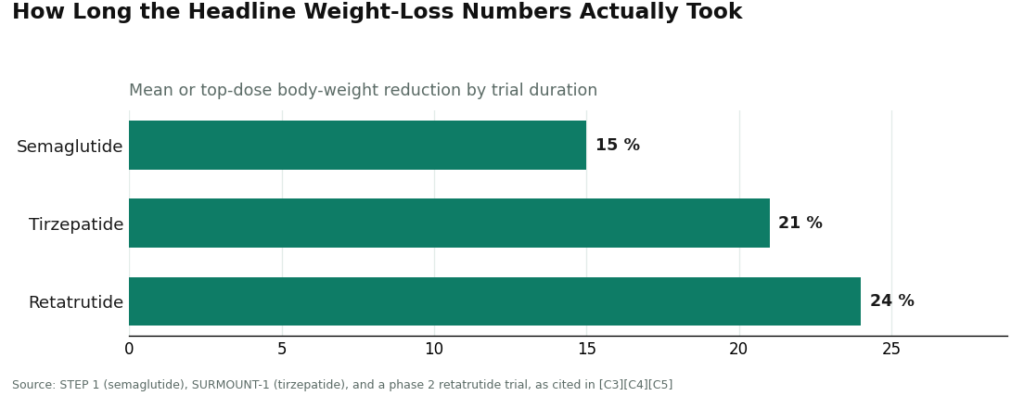
The practical takeaway: judge a GLP-1 in months, not weeks, expect a gradual ramp, and let the dose be titrated by someone qualified to do it. The evidence is genuinely strong. It’s evidence for a long, supervised course, not a fast one.
What about BPC-157 or other recovery peptides, is there a timeline for those?
Here’s where honesty gets a little uncomfortable, but it’s better than the alternative.
If BPC-157 is the compound in question, the honest answer is that there isn’t a solid human timeline to hand over. The published research is genuinely interesting, but it’s overwhelmingly preclinical. A 2026 review in Pharmaceuticals lays out proposed mechanisms across animal models of injury [C6]. That’s the actual state of things right now: animal data and hypotheses, not large controlled human trials that established how many weeks it takes a tendon to heal in an actual person. Anyone offering a confident “it works in two weeks” line isn’t citing evidence, they’re repeating a forum post.
So what should someone actually expect? Lower expectations than the marketing suggests. Anecdotes exist of people feeling something within a couple of weeks, and that experience might happen to any given person too, but it should be held loosely, because there is no robust human trial backing a specific timeline or even a guaranteed outcome. This is the bucket where marketing and evidence drift furthest apart, and where the certificate-of-analysis problem hurts most: if the vial can’t be verified and the underlying evidence is thin to begin with, that’s a maybe stacked on top of a guess. A supervised pathway helps with the verified-dose half of that equation and gives someone to check in with, but it can’t manufacture evidence that doesn’t exist yet. It makes the attempt safer and more accountable. It does not put a real timeline under a compound the science hasn’t caught up to.
What about SARMs, since Swiss Chems is known for those too?
There’s no “what to expect” timeline to give here, and that’s the honest answer. SARMs aren’t approved for human use, the FDA has flagged serious safety concerns including liver and cardiovascular risks, and there’s no supervised consumer pathway for them at all. The honest expectation isn’t a results calendar. It’s a risk not worth taking.
Does having a clinician involved actually change my timeline, or is that just a safety thing?
It changes both, and here’s the connection people miss.
On a self-sourced vial, the timeline is one person alone, staring at a scale or a sore shoulder, with no way to confirm whether the dose is right or the vial is genuine. On a supervised pathway, the timeline becomes a managed process instead of a guess: the dose starts low and gets titrated based on actual response, side effects get addressed rather than toughed out, adjustments happen at check-ins, and because the medicine is verified, a flat result actually tells someone something, instead of leaving them wondering if three months went into a bad vial.
That follow-up loop is the real difference between hoping and knowing. It’s also the honest reason supervised results tend to hold up better, not because the molecule is different, but because the process catches problems and corrects course along the way. The 2026 enforcement wave is nudging the whole category toward exactly this kind of managed access [C1][C2], and for a results timeline specifically, managed is what makes the calendar trustworthy in the first place.
So what’s the bottom line?
Using a GLP-1 means expecting a slow titration, a visible signal by around three months, and the headline numbers only after a year or more of supervised use, because that’s exactly how the trials measured them [C3][C4][C5]. Using a recovery peptide like BPC-157 means getting honesty in place of a timeline, because the human evidence to build one doesn’t exist yet [C6]. Either way, the timeline is only as real as the starting line, and a verified dose from a supervised pathway is what gives someone a starting line worth trusting, the clinician-and-pharmacy structure described above. It offers an honest, managed shot at a real result. It does not promise the result.
Frequently asked questions
How fast will I see results on a GLP-1?
Slower than the ads suggest, and that’s normal. Real dosing starts low and titrates up over the first weeks, a meaningful trend should show up by around three months, and the headline figures take much longer: semaglutide’s roughly 15 percent mean weight loss was measured at 68 weeks in STEP 1, with tirzepatide and retatrutide measured over similarly long horizons [C3][C4][C5]. Expect steady monthly progress over many months, not a fast transformation.
What is the realistic timeline for BPC-157 or similar peptides?
Honestly, there isn’t a solid human timeline to give. The evidence for BPC-157 is overwhelmingly preclinical, animal models and mechanistic reviews rather than large human trials [C6]. Anecdotes exist, and some people experience them, but they should be held loosely, since no robust human trial backs a specific timeline or outcome. This is the bucket where marketing and evidence diverge the most.
Why does where I buy affect my timeline?
Because a timeline depends on a trustworthy starting line. With a self-sourced vial, a certificate of analysis verifies a sample, not the specific vial in hand, so a slow result could mean the compound didn’t work or the vial was off, with no way to tell which. A supervised pathway provides a per-batch-verified medicine and a clinician-set dose, so the results being read are an actual signal [C1][C2].
Does a supervised pathway guarantee I get results?
No, and any honest answer says so upfront. A supervised pathway offers a verified dose, clinician oversight, titration, and follow-up, which adds up to the best honest shot at a real and safe result. It improves the odds and the safety. It does not promise the outcome.
Are there legitimate alternatives to research-chemical sites like Swiss Chems for getting peptides?
Yes, and the main ones operate under actual medical oversight rather than a “research use only” label. Licensed compounding pharmacies that require a prescription are the most defensible route, since a prescribing provider reviews labs and health history before anything ships. That accountability layer matters both for safety and for getting a compound that’s actually dosed correctly, which directly affects the timeline.
Is Swiss Chems legit, or is it a scam?
The honest answer is complicated. Many buyers report receiving products, so it doesn’t appear to be a straightforward scam in the take-your-money-and-vanish sense. The real problem sits in legal and quality-control gray areas. Without independent third-party certificates of analysis for every batch, and with no medical supervision built in, there’s no reliable way to confirm purity or dosing accuracy, and both directly affect whether results show up on any meaningful timeline.
What should I look for in a Swiss Chems alternative to know I’m not just trading one sketchy source for another?
Three things: a required prescription from a licensed provider, a state-licensed compounding pharmacy filling the order, and batch-level certificates of analysis that can actually be requested. Sites like FormBlends operate on this physician-supervised model, which builds in a real accountability chain. If a seller skips any of those three steps, the risk profile stays roughly the same no matter how polished the website looks.
Does switching to a more reputable source reset my results timeline, or do I pick up where I left off?
It depends on what was being taken before and whether it was accurately dosed. If someone was getting underdosed or mislabeled compound, switching to a verified source can feel like starting over, because the body may be responding to a correct dose for the first time. Give it at least the same window a fresh start would get, typically four to twelve weeks depending on the compound, before drawing conclusions about efficacy.
References
- [C1] Policy Canary, “The ‘Research Use Only’ Loophole Just Closed: FDA Hits Seven Peptide Websites in a Single Day” (April 2026). Documents and quotes the FDA warning letters posted April 7, 2026 and dated March 31, 2026 to sellers including Gram Peptides and Prime Sciences, including the FDA statement that despite “Research Use Only” labeling, website evidence established the products were intended as drugs for human use.
- [C2] Health Law Alliance (Martha Rumore, Esq.), “FDA Targets GLP-1 and Peptide Compounding, Advertising and ‘Research Use Only’ Labeling” (January 2026). Documents the September 2025 wave of 50-plus FDA warning letters over compounded GLP-1 marketing and peptides sold “research use only,” and the position that.
- [C3] Wilding JPH, et al. “Once-Weekly Semaglutide in Adults with Overweight or Obesity.” New England Journal of Medicine, March 18, 2021 (STEP 1 trial; mean weight reduction measured at 68 weeks). https://pubmed.ncbi.nlm.nih.gov/33567185/
- [C4] Jastreboff AM, et al. “Tirzepatide Once Weekly for the Treatment of Obesity.” New England Journal of Medicine, July 21, 2022 (SURMOUNT-1 trial). https://pubmed.ncbi.nlm.nih.gov/35658024/
- [C5] Jastreboff AM, et al. “Triple-Hormone-Receptor Agonist Retatrutide for Obesity, A Phase 2 Trial.” New England Journal of Medicine, August 10, 2023;389:514-526.
- [C6] Sikiric P, et al. “Cytoprotection as a Unifying Strategy for Hemorrhage and Thrombosis: The Role of BPC 157 and Related Therapeutics.” Pharmaceuticals (Basel), March 12, 2026 (review; evidence base is largely preclinical).