Spring Starter Diesel Engine Systems: A Technical Deep Dive
Understanding how a spring starter diesel engine system works at a technical level helps engineers, technicians, and procurement specialists make better decisions and get more value from their equipment. This technical overview covers the key engineering principles, design considerations, and performance factors that determine how well a spring starter system serves its diesel engine application.
Diesel Engine Starting Dynamics
Starting a diesel engine involves a sequence of events that must occur in the correct order and at sufficient speed for ignition to occur. The starter must accelerate the crankshaft from rest to the minimum cranking speed, typically 100-250 RPM. During this acceleration, it must overcome static friction, oil viscosity resistance, and the compression pressure in each cylinder as it passes top dead center.
The power required for this starting sequence peaks at the beginning of cranking, when static friction is greatest, and again at each compression stroke. The starting system must provide sufficient torque throughout this sequence, with adequate margin for degraded conditions such as cold temperatures and aged lubricants.
Spring Design Parameters
Natural Frequency Considerations
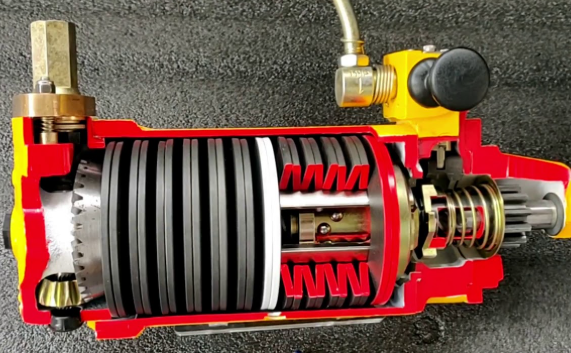
The spring’s natural frequency must be considered in the design to prevent resonance during release. If the spring’s natural frequency coincides with the rotational frequency of the drive assembly, energy transfer becomes erratic and gear loading can spike dangerously. Well-designed spring starters avoid this resonance condition through careful frequency management.
Progressive vs. Linear Spring Rates
Standard coil springs have linear spring rates—constant force per unit of compression. Progressive spring designs increase stiffness as compression increases, allowing more energy storage in the same physical space. Progressive springs are increasingly used in high-performance spring starter designs to maximize energy density.
Spring Pre-load and Engagement Timing
Spring pre-load—the tension maintained in the spring even at its fully released state—affects engagement dynamics. A properly pre-loaded spring begins engagement smoothly, preventing the harsh impact that can occur when a fully relaxed spring suddenly begins driving the gear train. This design detail significantly affects drive component longevity.
Drive System Engineering
The drive system must accomplish several conflicting objectives simultaneously:
- Engage the ring gear smoothly and quickly without impact
- Transfer maximum energy while minimizing losses
- Disengage positively after the engine starts to prevent overspeed
- Withstand repeated high-impact cycles without fatigue failure
- Maintain engagement through the complete starting sequence
Thermal Management in High-Frequency Starting
Applications requiring frequent starting cycles generate heat within the spring starter assembly through internal friction. This heat must be managed to prevent excessive spring temperature that could affect performance or longevity. High-frequency applications may require additional thermal analysis to ensure that the spring starter can handle the duty cycle without overheating.
Vibration and Shock Loading
Industrial installations subject spring starters to significant vibration and shock loading. Engine vibration, vehicle motion, and installation-related factors all contribute. Spring starter designs must account for these loads through appropriate fastener design, vibration-damping mounts, and structural analysis of the housing and mounting brackets.
See also: How Technology Is Reshaping Transportation Systems
System Integration Considerations
Modern diesel spring starter systems increasingly integrate with engine management and facility monitoring systems. Integration points may include spring position sensors that verify full charge status, release confirmation sensors, fault indicators, and remote triggering interfaces. These integration capabilities should be specified during the selection process and verified during commissioning.
Frequently Asked Questions
How does engine wear affect spring starter sizing?
As engines wear, compression ratios may decrease slightly, reducing starting resistance. More importantly, worn rings and valve seals increase starting resistance through blowby. When sizing for older engines, it is wise to include additional margin to account for these wear effects.
Can a spring starter be used for engine motoring as well as starting?
Spring starters are designed specifically for the starting cycle. For applications requiring sustained engine motoring (rotating an engine without combustion for testing or break-in purposes), different starting system approaches are more appropriate.
How are spring starters tested before delivery?
Quality manufacturers perform comprehensive factory testing including spring tension verification, engagement and release functional testing, and sometimes complete starting simulation. Request test reports as part of the delivery documentation.
Conclusion
A thorough technical understanding of spring starter diesel engine systems enables better specification decisions, more effective installation practices, and more insightful maintenance protocols. The engineering detail behind these devices reveals why they perform so reliably in demanding applications and provides the knowledge base needed to get maximum value from this proven starting technology.